Ergonomics Reset: How to Properly Adjust Your Desk, Chair & Monitor in 15 Minutes
If your home office setup is currently more “sort of works” than really works: You’re not alone. The good news: You don’t need a complete overhaul. Often, 15 minutes is all it takes to noticeably improve your posture, comfort, and focus.
Here is your ergonomics reset in 5 simple steps—no technical jargon, just immediate results.
TL;DR (in 30 seconds):
- Adjust the desk height so your shoulders stay relaxed
- Chair: Feet flat, knees at approx. 90°, back well supported
- Monitor: Top edge at approx. eye level, distance ~ one arm’s length
- Keyboard/mouse close by—elbows at your sides
- Mini-routine: stand up briefly every hour
Step 1: Adjust the Desk Height—The Foundation
If the desk height isn’t right, your body automatically compensates. Usually by shrugging your shoulders or “craning your head forward.” This drains energy—and after a few hours, it simply feels terrible.
Check: The Right Desk Height While Sitting
- Forearms rest comfortably on the desk
- Elbows at approx. a 90° angle
- Shoulders stay relaxed (not shrugged)
- Wrists straight (not bent)
Check: The Right Desk Height While Standing
- Same rule: rest your forearms comfortably on the desk, shoulders relaxed
- Distribute your weight evenly (don’t lean on one leg)
- Move slightly: shift your weight instead of standing rigidly
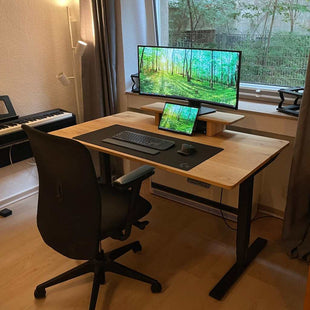
If you want to switch regularly between sitting and standing, height-adjustable desks make it super easy in everyday life.
Step 2: Adjust the Chair—Happy Back, Focused Mind
Even the best desk won’t help much if you “sink” into your chair. Adjust it properly once—it’s one of the fastest ways to improve comfort in your home office.
Quick Setup in 60 Seconds
- Seat height: Feet flat on the floor, knees at approx. 90°
- Seat depth: A hand’s width should fit between the back of your knees and the seat edge
- Backrest: supports the lower back—upright but relaxed
- Armrests (if available): high enough so your shoulders stay relaxed
Mini-hack: If you often lean forward, it’s usually because your screen or keyboard is too far away.
Step 3: Monitor Height—The Neck Game-Changer
This is where most mistakes happen. And this is exactly where neck tension often starts.
The 3 Rules for the Perfect Monitor Position
- Top edge of the monitor at approx. eye level
- Look slightly downward (not upward)
- Distance: approx. one arm’s length
Laptop Rule (Important!)
If you work on a laptop: Raise the laptop and use an external keyboard/mouse. Otherwise, you’ll constantly look down—and your neck will pay the price sooner or later.
You can find helpers for more space and better height here: Home Office Accessories.
Step 4: Keyboard & Mouse—Small Adjustments, Big Impact
If your mouse and keyboard are “too far away,” your elbows drift outward and your shoulders automatically tense up. You often don’t notice it until the end of the day.
Mini-Checklist
- Keyboard close enough so your elbows stay at your sides
- Mouse at the same height as the keyboard
- Wrists straight, not bent
Pro tip: A desk mat can make your setup quieter and more comfortable—less sliding, less noise, a cleaner desk.
Step 5: Your Daily 2-Minute Ergonomics Routine
Ergonomics isn’t a “set it once and forget it” thing. Your body loves variety. That’s why a mini-routine you actually stick to really helps.
- Every 60–90 minutes: stand up briefly, relax your shoulders
- 2–3 standing sessions a day: 10–15 minutes is enough to start
- At the end of the day: 2 minutes of cleaning your desk (you’ll start the next morning with a clear head)
If you want to make your setup more ergonomic and organized, you’ll find the right categories here:
Mini-Check: 15 Minutes—And You’re Done
- Desk height adjusted
- Chair properly adjusted
- Monitor at eye level
- Keyboard/mouse optimized
- Break timer set
FAQ
How can I tell if my monitor is too low?
If you often tilt your head down or experience pressure in your neck, your monitor is probably too low—especially when using a laptop.
How often should I switch between sitting and standing?
Start small: 2–3 standing sessions of 10–15 minutes each per day. The key is to switch regularly, not to “tough it out” while standing.
What is the fastest ergonomics fix with the biggest impact?
Monitor at eye level + desk height adjusted so your shoulders stay relaxed. You’ll feel it immediately.
Conclusion
An ergonomics reset isn’t a major project—but it is a real everyday hack. When your desk height, chair, and monitor are right, you’ll usually work with more focus, feel more relaxed, and experience less tension. 15 minutes that pay off every day.